
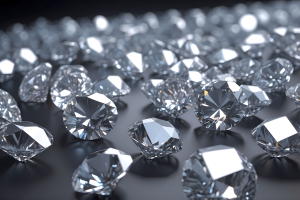
 The Sparkling Story of Diamonds: From Earth’s Depths to Humanity’s Desire
Diamonds are magic, plain and simple. They’ve been seen as nature’s ultimate symbols of strength and breathtaking beauty, glittering everywhere from ancient royal crowns and museum displays to the most important rings we wear. Every single one carries a deep history and a sense of enduring mystery in its sparkle.
But how did we even discover these rare stones in the first place? And what incredible transformation took them from hidden crystals in the earth to the most celebrated, iconic gemstones in the entire world?
Let’s dive into that fascinating journey—tracing diamonds from their fiery, deep-earth beginnings all the way to their rise as a global symbol of love and luxury.
Born in Fire, Forged in Time
Before humanity even knew what a diamond was, nature had already been perfecting them for billions of years.
Here’s the mind-blowing part: a diamond is simply made of carbon, the same common element you find in pencil lead or coal. What makes it a diamond is the impossible environment where it’s born: roughly 90 to 120 miles beneath the Earth’s surface. Down there, the temperature rockets past 1,000 degrees Celsius, and the pressure is absolutely immense.
Under extreme conditions, carbon atoms form a tight crystal structure, making diamonds the hardest natural material. Powerful volcanic eruptions then transported these crystals through magma channels.—called kimberlite pipes—and finally depositing them closer to the surface where we could eventually find them.
Think about that: every diamond we see today is a piece of the earth’s deep, fiery history, often over a billion years old. Holding one truly is like holding a piece of crystallized time.
Who First Discovered Diamonds?
The true human story with diamonds actually starts in India, roughly 2,500 years ago.
Historical records show that diamonds were first mined along the rivers in India’s famous Golconda region. These initial stones were not the shiny, polished gems we recognize today; rather, they were likely valued as uncut crystals. Their worth came more from their remarkable hardness and extreme rarity than from their sparkle.
Ancient Indians believed that diamonds were more than mere stones; they thought these gems possessed mystical powers. Kings and merchants often wore them as protective talismans, believed to ward off evil and bring good fortune. Traders quickly realized their value and began exchanging them along global routes.
By the 4th century BCE, diamonds had become a serious luxury item in India and were starting to journey to distant lands, thanks to trade routes reaching the Middle East and Europe. Even major Greek thinkers like Plato and Aristotle knew of them, often writing about diamonds and associating them with invincibility.
Diamonds on the World Stage
For centuries, the entire world’s diamond supply came from India.
That all changed dramatically in the early 18th century when massive deposits were found in Brazil. This discovery totally shook up the market, instantly giving European royalty and aristocrats access to diamonds on a much larger scale than ever before.
Then came the real game-changer in the 19th century: the enormous diamond fields of South Africa. The rush began with a lucky break in 1867, when a boy named Erasmus Jacobs found a shiny stone on a riverbank—it turned out to be the 21-carat “Eureka Diamond.”
Significant finds, including the 83.5-carat “Star of South Africa,” turned South Africa into the diamond trade’s center, making diamonds more accessible yet still symbols of wealth.
The Birth of a Diamond Empire
With a sudden flood of diamonds pouring out of South Africa, the massive supply threatened to completely crash their value. Something had to be done to control the market.
The solution arrived in 1888 when British businessman Cecil Rhodes founded De Beers Consolidated Mines. This company didn’t just control the world’s most productive mines; they essentially came to dominate the entire diamond trade for over a century.
But their real genius was in marketing. Their most famous move came in the 20th century with one of the greatest slogans ever created: “A Diamond is Forever.” Launched in 1947, this campaign was brilliant. It linked diamonds directly to love, marriage, and eternal commitment. Suddenly, diamonds weren’t just for the extremely wealthy anymore—they were transformed into the essential symbol of romance. The diamond engagement ring, which had once been a rarity, became an absolute staple of Western culture.
Science Meets Sparkle
While history and marketing gave diamonds their incredible cultural status, science is what explains their enduring magic.
Every diamond is judged by the “Four Cs”: carat (size), cut, color, and clarity. A perfectly cut diamond is particularly amazing because of the way it handles light. It’s engineered to reflect that light out, creating an almost unmatched brilliance and making it genuinely seem to sparkle from within.
But they’re not just beautiful; diamonds are also immensely practical. Their extreme hardness makes them invaluable in everything from construction to high-tech manufacturing. Think about it: diamond-tipped tools can slice through almost any material. We also rely on synthetic diamonds in sensitive electronics and scientific equipment.
In the end, diamonds truly straddle both worlds: they are dazzling symbols of love and luxury, and at the same time, they’re essential tools of modern progress.
From Rarity to Icon
The diamond’s incredible journey is truly a story of human imagination.
Ancient Indians treated them as powerful talismans. European royalty used them as the ultimate status symbol. Today, couples exchange them as a promise of everlasting love. Every generation has projected its own meaning onto these sparkling stones, shaping them into timeless cultural icons.
Diamonds are rare, radiant treasures that remind us of the extraordinary beauty that can emerge from intense pressure and heat.
Conclusion: More Than Just a Stone
The whole story of the diamond is essentially a story of transformation.
It’s carbon deep in the earth, becoming a crystal. It’s rough stones collected from riverbeds transformed into polished gems. This industry thrives on rarity and has grown into a global empire. And finally, it’s a mineral once valued only for its sheer hardness, evolving into a universal symbol of love.
So, when we look at a diamond today, we’re seeing much more than just a glittering gem. We are witnessing a fragment of the Earth’s ancient history, showcasing human ingenuity in craftsmanship and centuries of cultural significance. From ancient Indian talismans to modern engagement rings, diamonds continue to captivate us. It’s genuine proof that beauty formed under pressure really can last forever.