
The Ostrich: The Biggest Bird in the World and the Giant of the African Plains
When people think of birds, they often envision graceful creatures like eagles and flamingos. However, the true heavyweight champion of the skies is the ostrich—the largest bird in the world. Unlike its flying counterparts, the ostrich thrives on speed, strength, and survival. Let’s explore this remarkable creature’s size, diet, habitat, and unique adaptations that make it one of Earth’s most fascinating animals.
The Name and Legacy of a Giant
The name “ostrich” actually comes from the Greek word strouthokamelos, which translates to the odd yet perfect description: “sparrow camel.” It’s ideal because the ostrich is a long-necked, long-legged bird that towers above others like a camel, but still belongs to the feathered bird family.
Ostriches belong to a group called ratites—flightless birds that have flat breastbones—a group that also includes emus, rheas, cassowaries, and kiwis. But the ostrich truly reigns supreme among them all. It’s not only the largest living bird, but also one of the oldest, with fossils suggesting its ancestors have been striding across Earth for over 60 million years.
The Size That Defies Belief
If there were a “Guinness World Record” for sheer bird brawn, the ostrich would win every single year.
Adult male ostriches can grow up to 9 feet (approx. 2.7 meters) tall and weigh as much as 340 pounds (approx. 155 kilograms)—roughly the size of a motorcycle. Females are slightly smaller, but still impressive, standing around 6 to 7 feet tall.
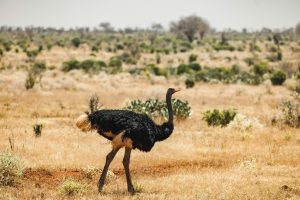
Their wings, though useless for actual flying, are massive and beautifully feathered. Ostriches use them for balance while running, for dramatic courtship displays, and even for shading their young from the scorching African sun. Their feathers are soft and fluffy, designed for temperature control more than for aerodynamics.
But perhaps their most famous features are their legs—long, muscular, and powerful enough to deliver a kick that can kill a lion. Each foot has only two toes, an unusual trait, but one that allows for maximum running efficiency. Ostriches are the fastest two-legged runners on Earth, capable of sprinting at speeds of up to 70 kilometres (43 miles) per hour.
When danger approaches, flight isn’t an option—but escape certainly is.
The Land They Call Home
Ostriches are native to Africa, where they roam the vast savannas, deserts, and open plains. They naturally gravitate toward dry, hot environments with plenty of space for them to sprint and forage. Today, you can find them across many African countries, from South Africa and Namibia to Kenya and Ethiopia.
They are incredibly well-adapted to these harsh conditions. Ostriches can survive for long stretches without drinking water, drawing all the moisture they need from the plants they eat. Their bodies are built for efficiency: they pant like dogs to cool down, their fluffy feathers provide shade, and their eyes—the largest of any land animal—help them spot predators from miles away.
Interestingly, ostriches weren’t always confined to Africa. Fossil records show that ancient relatives once roamed parts of Asia and the Arabian Peninsula. But today, the African ostrich stands as the last of its kind, proudly carrying on a lineage that’s as old as time itself.
The Giant’s Diet: What Do They Eat?
While they might seem intimidatingly large, ostriches aren’t actually meat-eaters—they are omnivores, which means they eat both plants and small creatures.
Their diet is mostly made up of grasses, seeds, fruits, and leaves, but they’ll definitely grab insects, small reptiles, or a lizard when they come across them.
And yes, they’re famous for swallowing some bizarre stuff! Since ostriches don’t have teeth, they swallow things like sand, pebbles, and small stones to help grind up their food inside their gizzard (a muscular part of their stomach). In fact, in captivity, they’ve been known to gulp down shiny, non-food items like coins, which is certainly a bad idea, but proves how curious they are.
Their incredibly tough digestive systems can break down fibrous, hard-to-eat plants that most other animals can’t touch, giving them a big edge when surviving in the dry, unforgiving places they call home.
The Family Life of a Giant
Life in an ostrich herd is surprisingly social. They usually live in groups of five to fifty birds, led by one dominant male and a few key females. These groups work together for protection: while some ostriches are feeding, others are always keeping watch for predators like lions, cheetahs, or hyenas.
When breeding season arrives, the male ostrich turns into a real showman. He performs a mesmerizing dance—spreading his wings, rhythmically stamping his feet, and bowing his head to attract females. Once he successfully mates, the female lays her eggs in a shared nest dug right into the ground.
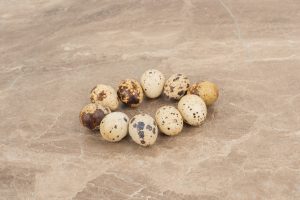
And those eggs! Ostrich eggs are the largest of any living animal, weighing up to 3 pounds (approx. 1.4 kilograms) each—that’s roughly the size of twenty-four chicken eggs combined. The male and female take turns guarding the nest, with the female sitting during the day (her dull colouring provides camouflage) and the male taking over at night (his darker feathers blend into the shadows).
When the chicks finally hatch, they’re already about the size of a chicken and can run within just a few hours—a crucial survival skill in their predator-filled world.
A Bird Built for the Modern World
While ostriches are powerful wild symbols of Africa, they’ve also become a significant part of human economies around the globe.
Ostrich farming has grown considerably over the last century, with people raising them for several products:
- Their meat is lean and high in protein.
- Their leather is considered one of the strongest and most luxurious materials in fashion.
- Their feathers are utilized for various purposes, ranging from ornate costumes to high-quality industrial dusters.
Despite this commercial use, wild ostriches remain absolutely crucial to Africa’s ecosystems. They help spread plant seeds and play a vital role in maintaining the balance of grassland habitats. Conservation efforts are continuously working to ensure these magnificent birds remain free and thriving in the wild.
The Essence of the Spirit
The ostrich is a creature full of contradictions. Think about it: it’s a bird that can’t fly but can outrun pretty much anything on land. It’s a giant that looks kind of awkward, yet moves with breathtaking grace. It’s a symbol of pure strength that manages to thrive in some of the world’s harshest environments.
Watching an ostrich sprint across the savanna is a remarkable sight. Its feathers ripple in the sunlight as its powerful legs pound the ground, showcasing nature’s ingenuity. Although it may not soar above the clouds, the ostrich has brilliantly mastered life on the ground—fast, fearless, and free.