
When Earth Was Deadly: The Ancient Time When Survival Was Almost Impossible
It’s easy to forget that the peaceful, blue-green world we call home was once anything but inviting. Long before we built cities or even dreamed of flying, Earth was a realm of roaring beasts, violent storms, and stifling heat.
Just imagine stepping outside only to find yourself face-to-face with a saber-toothed cat or a ten-ton mammoth. Or, even worse, imagine a world where the air itself could be lethal.
Let’s take a journey back in time to those terrifying eras when Earth truly was the deadliest place for humans to live. We’ll explore the creatures that ruled the planet and discover how the climate was unlike anything we experience today.
When the World Tried to End Itself
If you could hop in a time machine and go back hundreds of millions of years, you’d land in a world that felt both familiar and totally alien. You’d see forests, oceans, and mountains—but everything would be cranked up to the extreme. Volcanoes erupted constantly, continents were drifting wildly, and the oxygen levels kept swinging between being too high and too low.
One of the most dangerous times was the Permian Period, around 250 million years ago. Its ending is known by scientists as “The Great Dying”—the largest mass extinction in Earth’s history. Over 90% of all species vanished, wiped out by a deadly cocktail of supervolcano eruptions, toxic gases, acid rain, and a collapsing atmosphere. The sky turned red, the oceans became poisonous, and temperatures soared past what almost any life could handle.
Humans wouldn’t show up for another 248 million years, but if they had, survival would have been absolutely impossible. The air was thick with carbon dioxide, the ground was scorching hot, and the seas were bubbling with methane. It was as if the planet itself had gone completely mad.
Rise of the Giants
After the Great Dying, Earth slowly recovered—and when it did, it gave rise to some of the most fearsome creatures to ever walk the planet. Welcome to the Mesozoic Era, better known as the Age of Dinosaurs.
This was a time when reptiles truly ruled the land, sea, and sky. The continents were smashed together into one massive supercontinent called Pangaea, and the climate was warm and humid almost everywhere. Lush forests grew even near the poles, and there wasn’t a single ice cap to be found.
Then came the monsters.
The Tyrannosaurus rex, the so-called “king of the dinosaurs,” could crush bones with a bite force stronger than any predator alive today. The Spinosaurus, even bigger, stalked the waterways with crocodile-like jaws designed to catch giant fish. In the oceans, beasts like the Mosasaurus hunted other massive marine reptiles, while flying predators such as the Pteranodon glided above the waves.
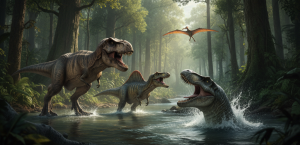
It was a world of giants—not just the animals, but the plants and insects, too. Some dragonflies had wingspans of more than two feet, and ferns grew taller than small houses. Oxygen levels were higher, which fueled this incredible explosion of size and strength.
It’s almost funny to think that if early humans had appeared during this time, we would have been nothing more than prey—tiny, fragile creatures trying desperately to hide from the thunderous footsteps of our scaly overlords.
When the Ice Took Over
Fast forward millions of years. The dinosaurs are gone, wiped out by a massive meteor impact that plunged the planet into darkness. Ash filled the sky, the sun vanished, and the plants withered. But out of that global catastrophe rose new rulers: the mammals.
By the time humans started to evolve, around 2.5 million years ago, Earth had entered another deadly phase: the Ice Ages. Instead of fiery skies and volcanic wastelands, now freezing temperatures and glacial winds dominated much of the world.
Vast sheets of ice stretched across North America, Europe, and Asia. Entire regions that are fertile and warm today were then buried beneath frozen walls taller than skyscrapers. The climate was so harsh that survival demanded intelligence, teamwork, and fire—tools that early humans were only just beginning to master.
But while the cold itself was dangerous, so too were the creatures that had adapted to it. The Ice Age wasn’t just cold—it was wild.
The Beasts of the Ice Age
Imagine walking across a snowy plain and hearing the distant trumpeting of a woolly mammoth, its massive tusks curling like ivory sabers. Nearby, a saber-toothed tiger—or Smilodon—prowls through the fog, its fangs nea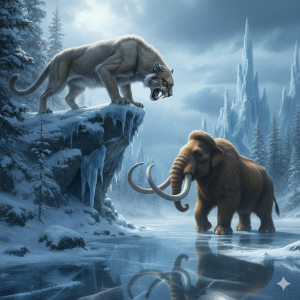 rly eight inches long. Packs of dire wolves hunt bison in the snow, while gigantic bears roam the tundra.
This was a brutal ecosystem where only the toughest could survive. Early humans had to compete with predators far stronger and faster than themselves. Our ancestors used sharp stones and wooden spears, but one single mistake could mean instant death.
Even climate shifts could wipe out entire tribes. Periods of sudden warming caused glaciers to melt, flooding vast areas, while new freezes could lock entire continents in ice. Food sources changed constantly—herds migrated, plants disappeared—forcing humans to adapt or perish.
Yet, ironically, it was this very chaos that helped make us who we are. Harsh conditions forced humans to invent tools, language, and cooperation—the same traits that would one day let us conquer the planet.
A Climate Unlike Today’s
If you compare ancient Earth to today’s climate, the differences are absolutely astonishing. Back then, the planet constantly swung between two lethal extremes: a fiery, greenhouse-like state and a frozen wasteland.
During the age of dinosaurs, the world was so warm that palm trees grew near the Arctic Circle. The air was thick with carbon dioxide, and sea levels were hundreds of feet higher. Tropical storms were common and ferocious, shaping coastlines literally overnight.
During the Ice Ages, however, everything completely reversed. Temperatures dropped drastically, huge ice sheets advanced, and massive dust storms swept across dry continents. Forests turned into deserts, and the oceans receded as water was locked up in glaciers.
In both extreme cases, life had to constantly fight for survival. The plants and animals that managed to adapt—or evolve—became the ancestors of all the species we know today.
From Hell to Home
The story of Earth’s deadly past isn’t just about destruction—it’s also a powerful story of resilience. Every time the planet nearly wiped the slate clean, life found a way to come back stronger, stranger, and more diverse than before.
For us humans, those dangerous eras shaped us in ways we can still feel today. Our instincts to explore, to adapt, and to fiercely protect one another come from ancestors who faced unimaginable odds—from Ice Age hunters to desert wanderers.
Earth might be gentler now, but its history reminds us how fragile that gentleness is. We live in a rare moment of stability, a peaceful pause in an otherwise violent cosmic story. And that makes our world—this fragile blue marble floating in space—all the more extraordinary.